
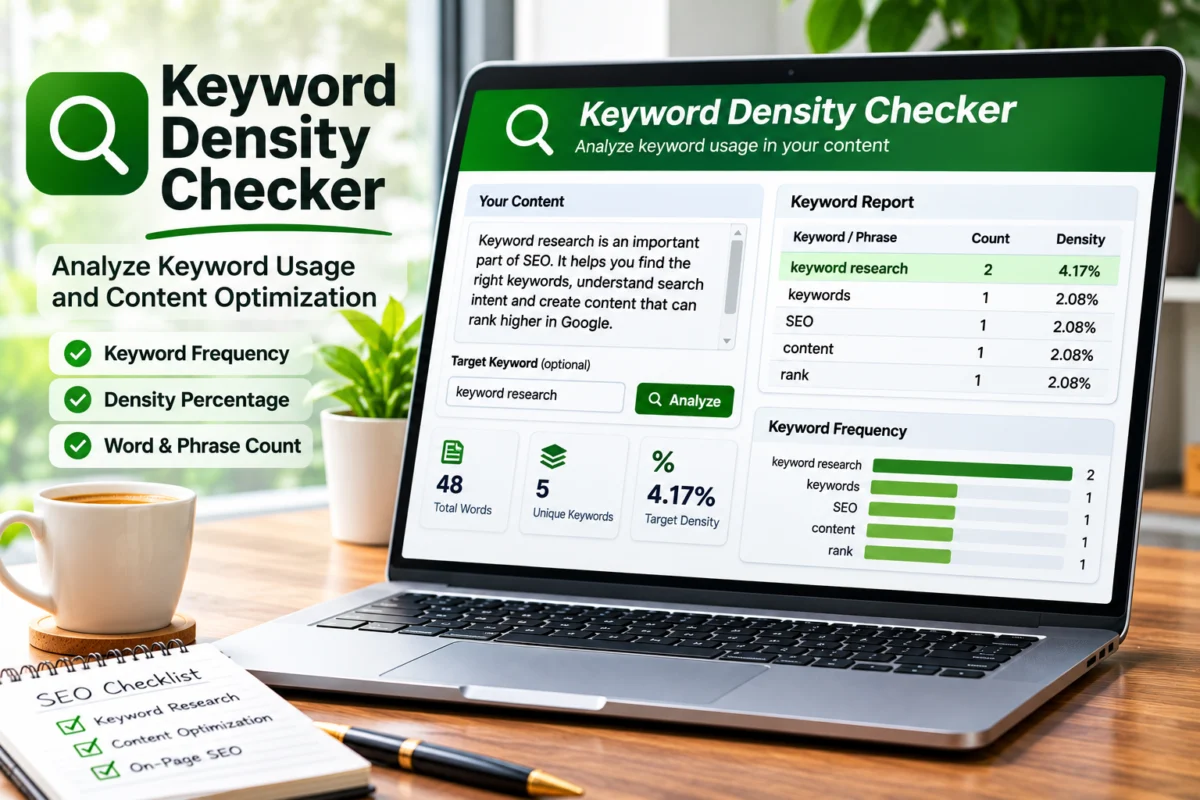
Review keyword frequency in a public webpage or analyse text directly in your browser. See word counts, repeated terms and an exact phrase percentage without chasing an arbitrary SEO target.
FREE SEO CONTENT ANALYSIS
Keyword Density Checker
Check how often words and phrases appear in your content. Use the results to identify repetition, review your writing and make clearer editorial decisions.
LOCAL TEXT ANALYZER
Check keyword density in your text
Paste text or an article excerpt. The analysis runs in your browser; your text is not sent to our server.
Enter some text and optionally add a phrase to measure.
TARGET PHRASE REPORT
Keyword phrase
Exact consecutive-word match · case-insensitive; punctuation ignored
Most frequent words
Common connector words are omitted from this list.
| Word | Count | Share |
|---|
Repeated two-word phrases
Adjacent phrases that occur more than once.
| Phrase | Count | Share |
|---|
Method: words are counted as letter/number sequences, with internal apostrophes retained. Target phrase occurrences are case-insensitive contiguous word matches; overlapping matches are counted. Density = matching occurrences ÷ total words × 100. This is a descriptive text metric, not a Google ranking score.
PUBLIC PAGE CHECK
Analyse keyword usage on a webpage URL
Use the embedded third-party service to submit a publicly accessible webpage for its own analysis.
The webpage URL and request are handled by SmallSEOTools Studio. Its page-fetching method, results, data coverage, limitations and availability are controlled by that provider. Do not submit private, restricted or sensitive URLs.
KEYWORD DENSITY GUIDE
Understand keyword frequency without over-optimising your content
Keyword density is a way to describe how often a word or phrase appears in a piece of text. It can help you notice repetition, but it cannot tell you on its own whether a page is useful, relevant or likely to rank.
What is keyword density?
Keyword density is a frequency measure that compares the number of times a word or exact phrase appears with the total number of words in the text being measured. Writers and SEO editors sometimes use it to spot repeated wording during a content review.
For example, if a 1,000-word article contains 10 occurrences of an exact phrase, its simple phrase density is 1%. This is an arithmetic illustration, not an SEO target.
Different tools may count text differently. One may analyse only the main article, while another may include headings, navigation, menus, footer text or other page elements. Phrase matching, punctuation and tokenisation methods can also change the result.
How to use this Keyword Density Checker
Use the local analyzer for text you paste, or submit a public page to the external URL checker.
In the local analyzer, add the exact word or phrase you want to measure. This field is optional.
Review the total word count, unique terms, phrase frequency and calculated percentage.
Read the passages where terms appear and decide whether repetition sounds natural and helps the reader.
Remove unnecessary repetition, clarify sentences and add helpful detail instead of chasing a percentage.
Check that edits preserve accuracy, readability, topic coverage and the purpose of the page.
Is there an ideal keyword density for SEO?
There is no universal keyword-density percentage that guarantees better Google rankings. Avoid forcing a phrase into a page to reach 1%, 2% or any other fixed number. A useful page may mention its topic naturally in the title, introduction and relevant sections, while the appropriate frequency will vary with the subject and length.
Google describes keyword stuffing as repeating words or phrases so often that the writing sounds unnatural, or placing keyword blocks on a page to manipulate Search. Its published spam policy does not define a “safe” density threshold.
What the density report can tell you
Shows how often a word or target phrase occurs in the analysed text.
Shows the frequency as a proportion of the total word count.
Helps identify terms and adjacent phrases that may deserve editorial review.
Provides a starting point for checking whether repeated language is useful and natural.
A density report cannot assess the full quality of an article, confirm search intent, judge factual accuracy, measure expertise or predict rankings. It is a narrow diagnostic, not a complete SEO audit.
How to improve keyword use naturally
- Write for the reader.
Explain the subject clearly and answer the question the page is meant to solve.
- Use the main phrase where it helps.
Include it naturally in descriptive page elements and relevant sections; do not repeat it mechanically.
- Choose precise words.
Use synonyms, related concepts and specific terminology only when they add meaning.
- Remove duplicated statements.
Replace repeated sentences with useful examples, evidence, explanations or steps.
- Keep headings reader-focused.
Make each heading describe the section rather than repeat the same keyword phrase.
- Read the final draft aloud.
Awkward repetition is often obvious when you hear the writing as a reader would.
Keyword density versus keyword stuffing
“This keyword research guide explains how to compare search intent, evaluate topics and plan a helpful content outline.”
The subject appears where it helps readers understand the page.“Keyword research guide, best keyword research, keyword research tips, keyword research tools for keyword research.”
The repetition is awkward and adds little information.Google’s spam policies describe keyword stuffing as excessive repetition intended to manipulate search rankings, including unnatural blocks of terms or phrases. Focus on whether the language is helpful and natural, not on an arbitrary numeric threshold.
Word frequency, phrase density and text length
The total word count affects a density calculation. If a phrase appears the same number of times in a shorter passage and a longer article, its percentage will be different. This is why a percentage should always be read alongside the occurrence count and the text that was analysed.
| Total words | Phrase occurrences | Calculated density |
|---|---|---|
| 500 | 5 | 1% |
| 1,000 | 10 | 1% |
| 2,000 | 20 | 1% |
The examples show only how the arithmetic works. They do not imply that 1% is better than another percentage or that pages should be expanded or shortened to reach it.
What is different between the two checkers?
Counts words and exact phrase occurrences directly in the text you enter. It runs in your browser and shows its counting method.
Submits a public webpage URL to a third-party service. Its extraction method, page coverage and reported metrics may differ.
QUICK ANSWERS
Frequently asked questions
Find clear answers about keyword frequency, density calculations and how to use the checker responsibly.
What does a Keyword Density Checker do?
It estimates how often words or phrases occur in the text being analysed. Use the number to notice repetition, not as a standalone measure of SEO quality.
Should I aim for 1% or 2% keyword density?
No fixed percentage is required. Use your topic phrase naturally where it helps readers understand the page and avoid repeating it solely to reach a target.
Does high keyword density automatically cause a Google penalty?
No single percentage automatically establishes a violation. Google’s keyword-stuffing policy focuses on excessive or unnatural repetition intended to manipulate Search.
How is keyword phrase density calculated in the local checker?
The local checker tokenises the pasted text into Unicode letters and numbers, matches the target phrase as consecutive words without case or punctuation differences, divides the number of matches by the total word count and multiplies by 100. Overlapping matches are counted.
Why can a URL checker show a different result?
It may extract page text differently, including navigation, headings, menus, footer content or dynamically rendered elements. Its provider also controls the tokenisation and phrase-counting method.
Can keyword density help with competitor research?
It can give you a limited view of repeated wording on a publicly accessible page. It cannot reveal a competitor’s full SEO strategy or prove why a page ranks.
Is keyword density enough to evaluate on-page SEO?
No. Also review search intent, useful information, page structure, internal links, originality, accuracy and reader experience.
Official references: Google Search spam policies, people-first content guidance and SEO Starter Guide.