
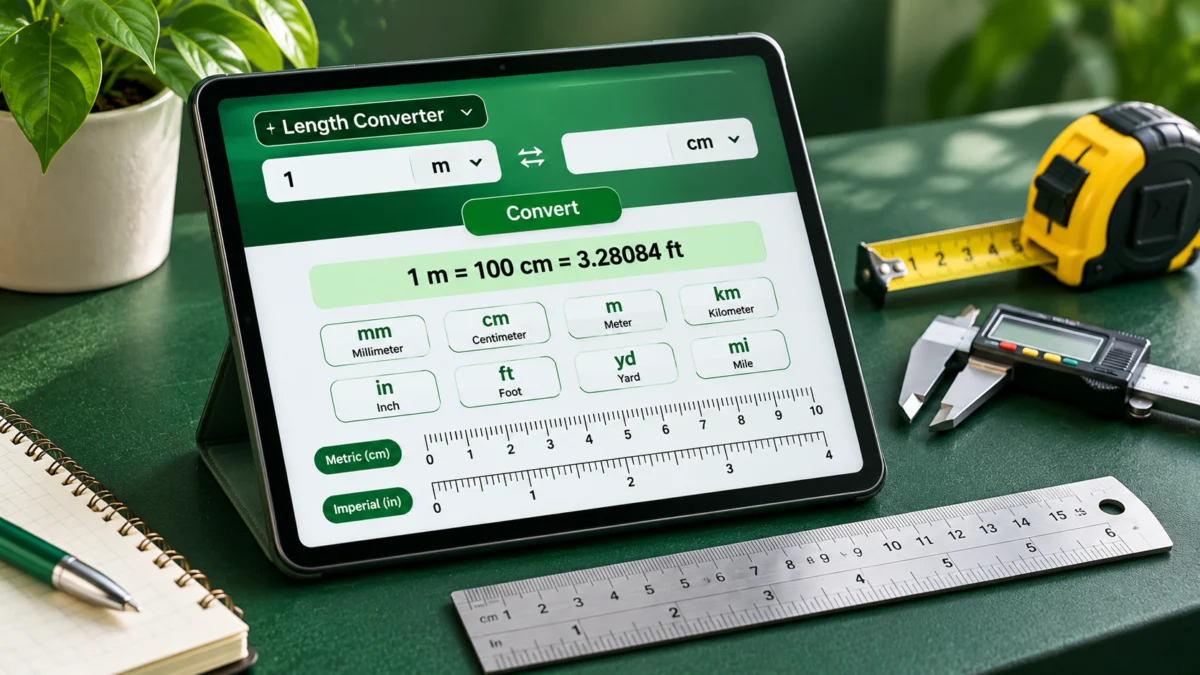
Use this free Length Calculator to convert measurements between metric and imperial units. Enter a value in millimeters, centimeters, meters, kilometers, inches, feet, yards or miles and see the equivalent measurements update instantly. Decimal values are supported, and calculations run in your browser.
Free online unit converter
Length Calculator
Enter a measurement in any field. All seven equivalent units update as you type, so you can convert metric to imperial or imperial to metric in one step.
Enter a value in any unit field to begin. Use zero or a decimal value when needed.
Results are displayed to up to 12 significant digits. This converter uses the international definitions of the inch, foot, yard and mile.
Understand and convert length measurements
Length describes the distance between two points. The metric system uses millimeters, centimeters, meters and kilometers, while many everyday measurements also use inches, feet, yards and miles. This guide explains how those units relate, how the calculator converts them and how to check a result before using it in a project.
How to use the Length Calculator
You can start with any of the eight input fields. The calculator does not require a separate source-unit or target-unit selection because all supported equivalents remain visible.
- Enter a non-negative measurement in millimeters, centimeters, meters, kilometers, inches, feet, yards or miles.
- Read the equivalent values displayed in the other seven fields. The conversion updates as you type.
- To convert from another unit, enter a value in that unit’s field. The calculator uses the new entry as the starting measurement.
- Choose an example button to try a sample measurement, or select Clear all fields to start again.
Input limits: The calculator accepts values from zero up to 1,000,000,000,000 in each unit. Decimal measurements are supported. Negative values and values above the limit are rejected.
Length units supported
Each unit is converted through the meter, the base unit of length in the International System of Units (SI). The factors below show how many meters are represented by one unit.
| Unit | Symbol | Equivalent in meters |
|---|---|---|
| Millimeter | mm | 0.001 m |
| Centimeter | cm | 0.01 m |
| Meter | m | 1 m |
| Kilometer | km | 1,000 m |
| Inch | in | 0.0254 m |
| International foot | ft | 0.3048 m |
| Yard | yd | 0.9144 m |
| International mile | mi | 1,609.344 m |
For an independent reference, consult the NIST Guide to the SI conversion factors, which documents standard length relationships and distinguishes the international foot from the U.S. survey foot.
The inch, international foot, yard and international mile use standard international definitions. This calculator does not use the U.S. survey foot, nautical mile or other specialist distance units. Check the unit definition required by your drawing, contract or technical specification before using a conversion for regulated work.
Length conversion formula
The converter first changes the entered measurement into meters. It then divides that meter value by the meter factor of the unit you want. Using one common base unit keeps conversions consistent in both directions.
General conversion formula: Target value = (Source value × Source factor) ÷ Target factor
For example, convert 10 feet to meters by multiplying 10 by 0.3048. The result is 3.048 meters. To convert 3.048 meters back to feet, divide 3.048 by 0.3048 to get 10 feet.
Metric example: To convert 250 centimeters to meters, multiply 250 by 0.01. The result is 2.5 meters. To convert meters to centimeters, divide the meter value by 0.01, which is the same as multiplying by 100.
Common length conversion examples
These examples are useful for checking everyday measurements and confirming that you have selected the correct unit.
- Metric conversions: 1 kilometer = 1,000 meters; 1 meter = 100 centimeters; 1 centimeter = 10 millimeters.
- Inches and feet: 1 inch = 2.54 centimeters; 12 inches = 1 foot; 1 foot = 0.3048 meter.
- Yards and miles: 1 yard = 3 feet; 1 mile = 5,280 feet; 1 mile = 1.609344 kilometers.
Worked example: To convert 5 kilometers to miles, divide 5,000 meters by 1,609.344. The result is approximately 3.10685596 miles. The calculator displays the result to up to 12 significant digits.
Metric and imperial measurement systems
The metric system: The metric system is based on decimal relationships. A kilometer contains 1,000 meters, a meter contains 100 centimeters, and a centimeter contains 10 millimeters. This makes many metric conversions straightforward because the units scale by powers of ten.
Imperial and customary units: Inches, feet, yards and miles are common in everyday measurements in the United States and in some other contexts. Twelve inches make one foot, three feet make one yard, and 5,280 feet make one international mile.
Use the measurement system specified by your project, product listing, drawing or assignment. When sharing a measurement, always include its unit symbol. A value such as 12 is ambiguous unless the reader knows whether it means 12 millimeters, inches, feet or another unit.
Where a length converter is useful
- Home improvement: Convert room dimensions, furniture sizes and material lengths when measuring or planning a space.
- Construction and design: Compare dimensions when plans, drawings or product specifications use different measurement systems.
- Education: Practice unit relationships, understand conversion factors and check classroom calculations.
- Travel: Understand distances on maps, road signs and travel information shown in kilometers or miles.
- Shopping: Compare clothing, furniture, electronics and other product dimensions listed in different units.
- Craft and DIY: Convert fabric, wood, hardware and hobby measurements before cutting or assembling materials.
Precision note: This is a general-purpose converter for the eight listed units. For surveying, engineering or regulated work, verify the exact unit definition and required rounding against the governing technical specification. Do not substitute the international foot for a legacy U.S. survey foot when a document explicitly requires the latter.
Frequently asked questions
Is the Length Calculator free to use?
Yes. The calculator is free to use in your browser and does not require an account or software installation.
Which units does this length converter support?
It supports millimeters, centimeters, meters, kilometers, inches, feet, yards and miles. Enter a value in any field to see the equivalents in the other seven fields.
Can I convert metric measurements to imperial units?
Yes. Enter a metric measurement such as meters or centimeters to see the equivalent inches, feet, yards and miles. You can also start with an imperial measurement and read its metric equivalents.
Can I enter decimal measurements?
Yes. Decimal values such as 1.75 meters or 12.5 inches are supported. Results are formatted to up to 12 significant digits.
How does the calculator convert between units?
It converts the entered value into meters using the source unit’s factor, then divides that meter value by the target unit’s factor. This method supports conversions in either direction.
Are the conversion factors exact?
The calculator uses standard international definitions, including 1 inch = 0.0254 meter, 1 international foot = 0.3048 meter, 1 yard = 0.9144 meter and 1 international mile = 1,609.344 meters. The displayed result may be rounded for readability.
Does the calculator use the U.S. survey foot?
No. It uses the international foot, defined as exactly 0.3048 meter. The U.S. survey foot is a separate historical unit and should only be used when a legacy specification explicitly requires it.
Are my measurements uploaded or saved?
The conversion script calculates values in your browser and does not send the numbers entered into the calculator fields to the calculator server. Standard website hosting and analytics may still process ordinary visit information.
Explore more free calculators
Continue with other practical tools from RankWithSeoTools: